
The (Really) Cold War
Arctic rivalry is intensifying; it's time to pay attention.

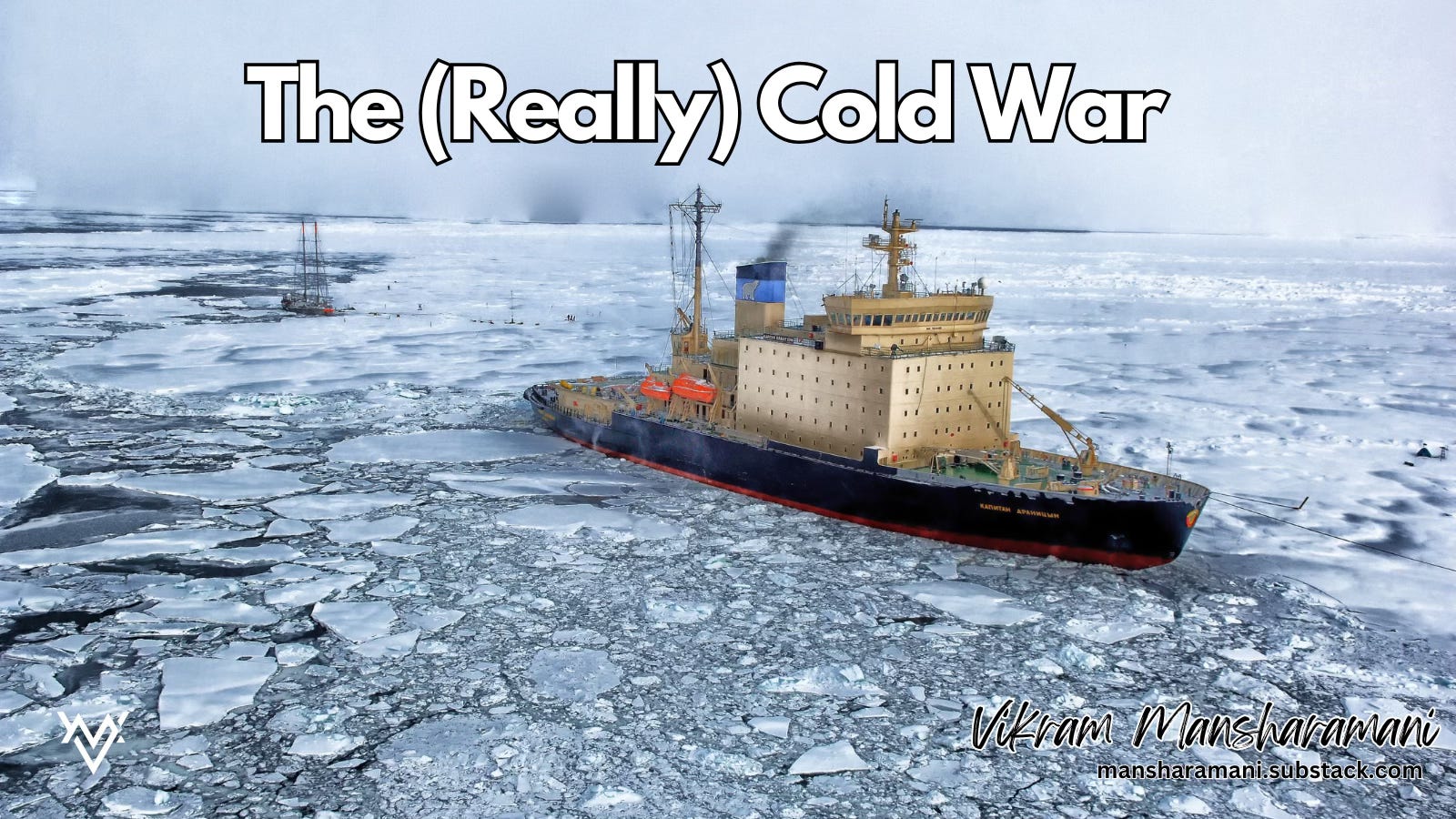
History may not repeat itself, but it often does rhyme. As resources become valuable, major powers scramble to secure access to them. But it’s not just the resources that matter, it’s the ability to get (to) them; inevitably, chokepoints emerge, and great powers start jockeying for position. In many cases, success in securing materials or trade routes is enough to reorient global power dynamics.
Rome conquered the Mediterranean in the 2nd century BC because it meant control of trade. For a thousand years (or so), the Silk Road drove empires from the Han Dynasty to the Mongols to battle for control of Central Asian corridors. The spice trade led the Portuguese and the Dutch into conflict over nutmeg in the 1500s and 1600s. The 1908 discovery of oil in Persia redrew the map of the Middle East, and we’re still fighting over those lines today. And Britain and Russia spent the entire 19th century playing what Kipling called the “Great Game” across Central Asia, with India as the grand prize. Battles over resources and trading routes is nothing new.
Today, another Great Game is underway in the north. As I have written before, I believe the next couple of decades will see a Great Power contest for the Arctic, and it is already heating up.
A Coherent Strategy Incoherently Described

Rising tensions in the Caribbean Sea and with Venezuela have led pundits and policymakers alike to ask questions about the coherence of the Trump Administration’s foreign policy. Many are confused, noting the seeming inconsistency of an America First rhetoric and the use of military force against an adversary. The
Why the Arctic? Well, for starters, it’s teeming with valuable resources. The U.S. Geological Survey estimates that the Arctic holds 90 billion barrels of undiscovered oil (around 13% of the world’s reserves) and 1,670 trillion cubic feet of natural gas, roughly 30% of the planet’s supply. The Wall Street Journal has estimated another $1 trillion in rare earth minerals, at today’s prices. The Russian Arctic alone holds $1.5 to $2 trillion in mineral wealth. And let’s not forget the Arctic already produces 40% of the world’s palladium, 20% of its diamonds, and 15% of its platinum.
But it’s not just about resources; it’s also about transit routes. Readers will know that I’ve been arguing for months that Trump’s seemingly incoherent geopolitical grandstanding about Greenland, the Panama Canal, and Canada aren’t random. I’ve suggested they represent a coherent strategy, albeit incoherently described. But they’re also about chokepoints.
The global economy runs through a handful of narrow passages: the Strait of Hormuz (oil), the Bab el-Mandeb and Suez Canal (Europe-Asia trade), the Strait of Malacca (China’s lifeline), the Panama Canal (Atlantic-Pacific), and the Turkish Straits (Black Sea access). Every major trade route on the planet runs through a bottleneck that a country or alliance can effectively shut.
A Coherent US National Security Strategy

Regular readers of my work know that I have been closely watching America’s foreign policy during Trump’s second term. While others saw incoherence or contradictions – destroying drug boats in the Caribbean but not those of the Houthi’s in the Red Sea, pulling back from much of the world while getting more engaged in South America, moving on from the Wa…
The Arctic bypasses all of them. The Northern Sea Route, running along Russia’s northern coast, shortens the transit time between Asia and Europe by 40% and saves 4,500 nautical miles—all while avoiding the Suez Canal, the Strait of Hormuz, and the Strait of Malacca. Further, the Northwest Passage through Canadian waters is increasingly safe for transit for more of the year. And Greenland? As you’ll see below, It sits at the mouth of both routes. Now ask yourself why Trump wants it.
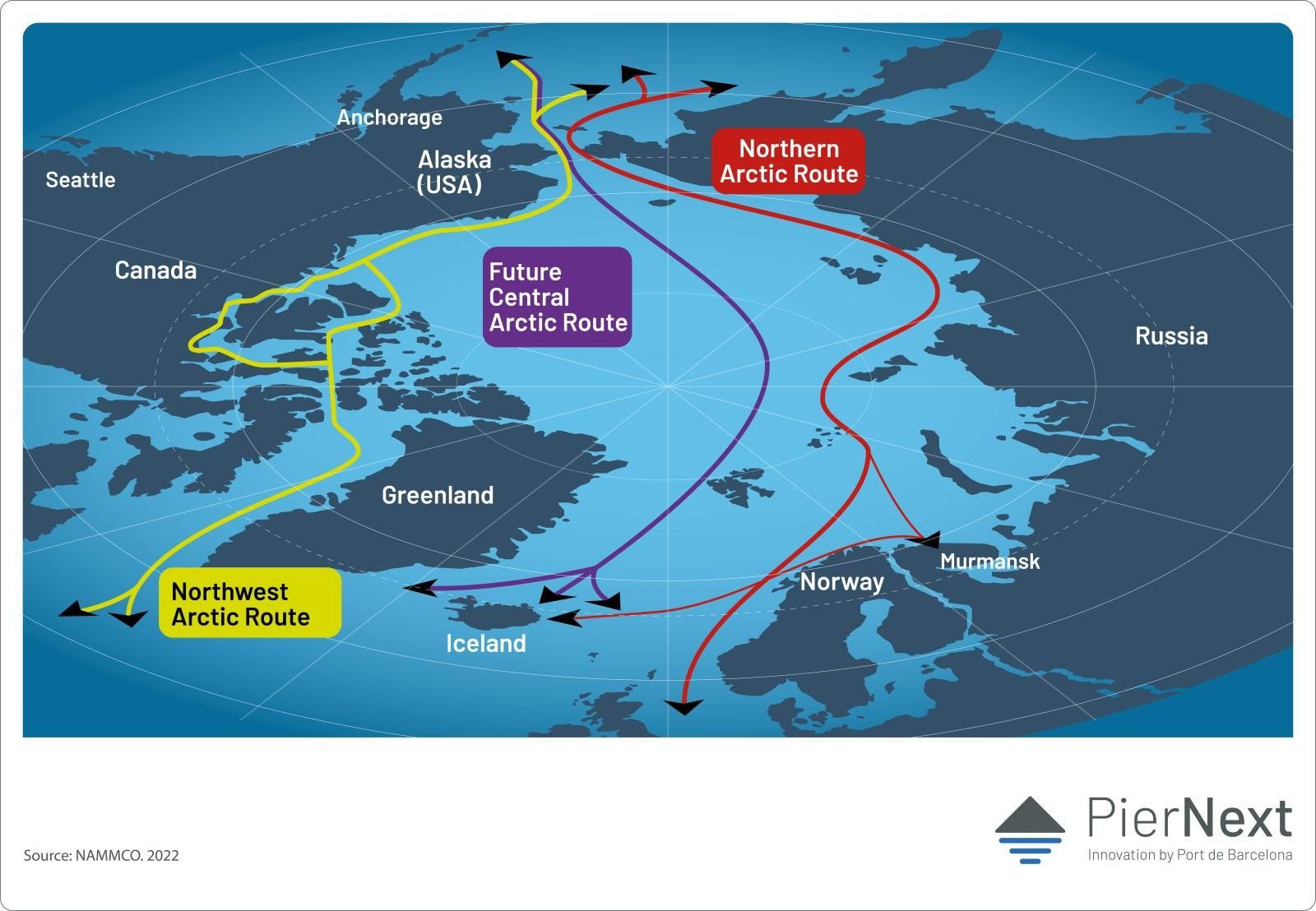
South Korea is so convinced of this future that it relocated its entire Ministry of Oceans and Fisheries to Busan from Seoul, a symbolic but important gesture. The first Korean container ships on the Arctic route are planned for this year. These aren’t hypothetical sea lanes that might one day carry goods. They’re under construction and the voyages are underway.
As they say, the game is afoot and the main players are ready to go.
Russia is already in the Arctic and very active. It has been reopening Soviet-era military bases, building new airfields and ports, and today operates the world’s largest icebreaker fleet, including dozens of nuclear-powered icebreakers that no other country can match. Russia today controls the Northern Sea Route and charges transit fees via mandatory icebreaker escorts, permits, and pilotage. The Arctic isn’t a sideshow for Moscow. It’s a part of its strategy.
China declared itself a “near-Arctic state” in 2018 (last I checked it’s not near the Arctic, but what do I know?) and outlined a “Polar Silk Road” for Arctic shipping. It has invested heavily in Russia’s Northern Sea Route and started working with Russia to patrol the Bering Strain in 2024. It’s even building its own icebreaker fleet. Beijing sees the Arctic the way it sees the South China Sea: contested space where early positioning creates future leverage.
Canada has been increasingly focusing on the north and Prime Minister Mark Carney recently announced the government would be investing more than $40 billion in forward operating locations, infrastructure to connect the North, and the development of critical materials. All part of Canada’s plan to shift from reliance to resilience, Carney’s administration hopes to develop the full economic potential of the region while improving its security footprint. For Canada, the Arctic isn’t some faraway and distant worry. It’s literally their doorstep.
Time To Defend Greenland

I recently wrote about Canada’s military preparing for a possible war with the United States. I suggested we might make sense of the seemingly shocking headline as an effort for global elites in Canada to bolster support for their diversification agenda.
The United States is playing catch-up, but Trump’s Greenland gambit jumpstarted the conversation about Arctic strategy, and the Pentagon recently deployed F-22s to Alaska. But the clearest measure of the gap: the U.S. has two operational icebreakers. Russia has over 40. Even Canada, our partner to the north, only has two large icebreakers and six medium sized ones. If freedom of movement through the Arctic is to be maintained, an icebreaker fleet is required.
NATO launched Arctic Sentry in 2026 and gained two Arctic members when Sweden and Finland joined. But Europe’s response remains symbolic. As I wrote earlier this year: The real threat to the Arctic isn’t America, it’s China and Russia. Europe seems to be posturing against the wrong adversary.
24 Global Developments to Watch Over the Next Five Years

2023 was a year of shocking developments on many fronts. From the surprise attack on Israel to the ongoing war in Ukraine and an increasingly likely conflict in South America, the world felt like it was unraveling in front of our eyes. Banks failed, credit card debt ballooned, inflation dissipated, and central banks “paused” their regular rhythm of rais…
So, why now? The Arctic and it resources have been there all along, after all. True, but most of it has been inaccessible. Until now.
The Arctic is opening in part because the ice is melting. A warmer climate has exposed the oil, the minerals, and the shipping lanes. But it’s also a frontier that hasn’t been fully exploited, and as the world bifurcates into two global economic and geopolitical blocks, a mad scramble is underway to secure much-needed resources.
The Race Is On, But Far From Over

Energy, which has usually meant oil, has been a driver of geopolitics for the past 100 years or so. As the internal combustion engine touched every aspect of life, fuel was needed for cars and trucks, industrial machines, and farm equipment. The world’s militaries transitioned away from coal-fired power and grew dependent upon gasoline to power tanks, p…
The spice trade lasted centuries. The oil game has been running for 118 years. The Arctic game is just starting—and it already has more players than any Great Game before it. Russia has nuclear icebreakers. China is building the Polar Silk Road. South Korea is redesigning its port system. The U.S. has a president who wants to buy Greenland.
Kipling would have recognized this. And written plenty about it. Who knows what great works it might one day inspire…

VIKRAM MANSHARAMANI is an entrepreneur, consultant, scholar, neighbor, husband, father, volunteer, and professional generalist who thinks in multiple-dimensions and looks beyond the short-term. Self-taught to think around corners and connect original dots, he spends his time speaking with global leaders in business, government, academia, and journalism. He’s currently the Chairman and CEO of Goodwell Foods, a manufacturer of private label frozen pizza. LinkedIn has twice listed him as its #1 Top Voice in Money & Finance, and Worthprofiled him as one of the 100 Most Powerful People in Global Finance. Vikram earned a PhD From MIT, has taught at Yale and Harvard, and is the author of three books, The Making of a Generalist: An Independent Thinker Finds Unconventional Success in an Uncertain World, Think for Yourself: Restoring Common Sense in an Age of Experts and Artificial Intelligence and Boombustology: Spotting Financial Bubbles Before They Burst. Vikram lives in Lincoln, New Hampshire with his wife and two children, where they can usually be found hiking or skiing.