
Tick, Tick, Tick...
A tiny arachnid is spreading a devastating meat allergy and the clock is ticking.

I have spent a career arguing that the most important signals rarely announce themselves. The skyscraper that tops out at the market peak. The pizza order that spikes in the Pentagon parking lot the night before a military operation. The private-label, single-serve trade-down in the frozen aisle that telegraphs a stressed consumer months before the macro data confirm it. Connecting seemingly irrelevant dots is not a parlor trick. It is, I’d argue, the only reliable way to see around corners and navigate uncertainty.
And the latest dot that has caught my eye is the size of a poppy seed that no one on Wall Street is watching: a tick that is quietly building a short position in animal protein. At the root of the development is a disease the tick spreads. It’s a condition called alpha-gal syndrome, or AGS, for short. It is an allergy (often severe, sometimes fatal) — to a sugar present in almost every non-primate mammal. AGS essentially makes you allergic to meat.
You can catch AGS by being bitten. A tick injects alpha-gal into your bloodstream, your immune system learns to attack the molecule, and from that day forward a hamburger, a pork chop, a glass of whole milk, a gelatin capsule — even certain medications — can trigger hives, violent gastrointestinal distress, and, in the worst cases, anaphylaxis. A particularly cruel feature is the delayed onset of symptoms. Reactions usually arrive two to ten hours after the meal, long after the victim would ever think to blame dinner. A man eats a steak, wakes in the middle of the night throwing up and assumes it’s food poisoning. In reality, however, his blood chemistry was quietly re-engineered.
This is not a fringe diagnosis, and recent data should catch everyone’s attention. On July 2, the CDC published a seroprevalence study that should alarm any consumer-staples analyst: In the five states with the highest burden, an estimated 24 percent of adults carry alpha-gal antibodies, led by Arkansas at 31.2 percent and Missouri at 26 percent. Now, it is important to note that a positive antibody test is not a confirmation of AGS. Only a minority of sensitized people go on to develop the full syndrome, and the CDC’s own authors warn against overdiagnosis. But for anyone on the lookout for potential economic fires, the magnitude of the kindling is stupefying. The CDC estimates as many as 450,000 Americans have confirmed AGS, roughly 0.14 percent of the population. The sensitized pool sitting one bad tick season away is vastly larger.
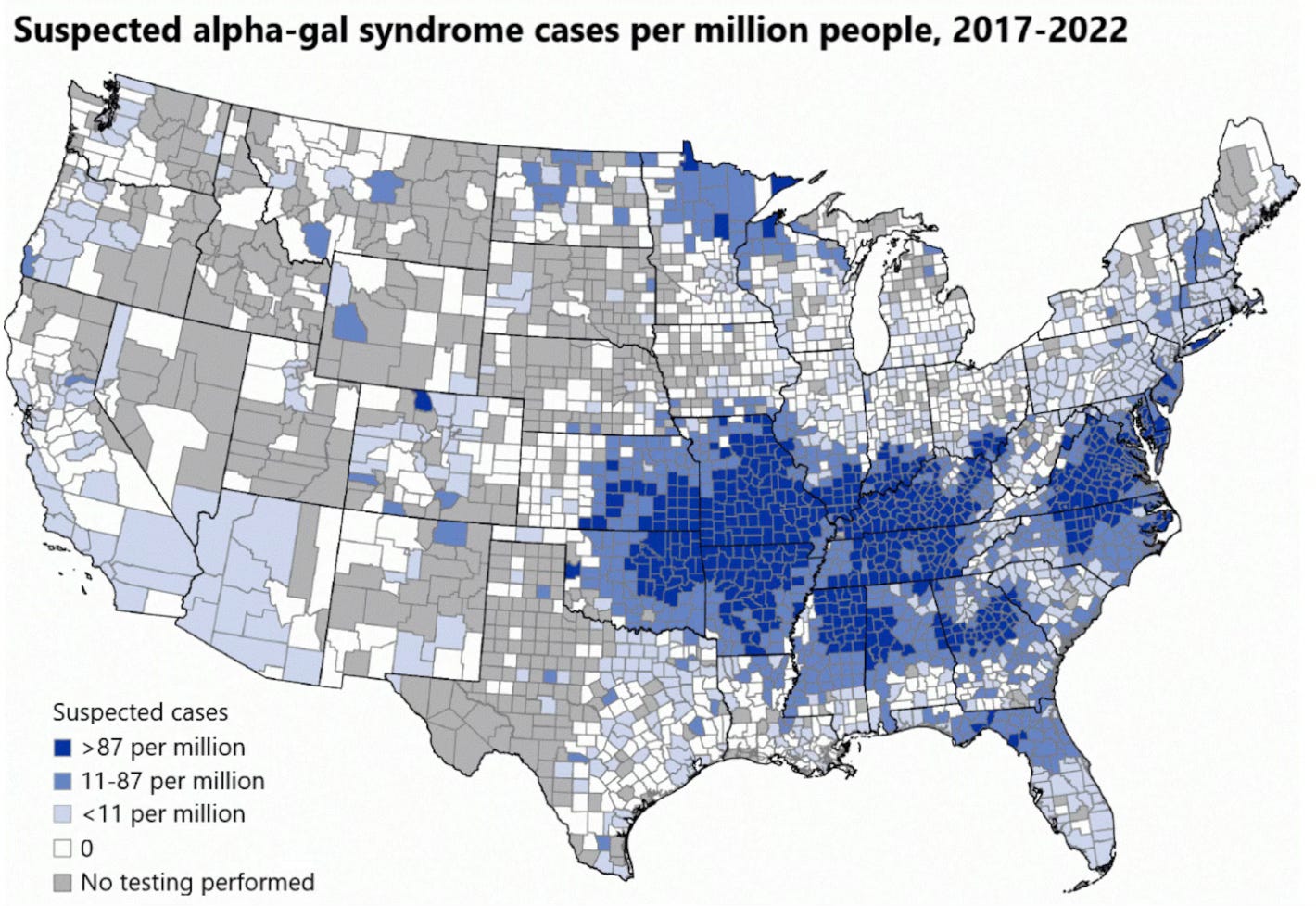
Interestingly, there’s also surging diagnoses in areas that have the ability to move markets. On Martha’s Vineyard, the hospital went from nine alpha-gal tests and two positives in 2020 to nearly 1,700 tests and 742 positives in 2025; that’s a positivity rate north of 40 percent. Nantucket sits on the same curve. On Long Island, a single Southampton allergist now manages more than 1,100 cases. These are not Appalachian hollows. They are the summer addresses of hedge fund managers, private-equity chairmen, and the people who set the clearing price of beachfront everything.
When a disease colonizes the Vineyard, Nantucket, and the Hamptons simultaneously, it has entered the bloodstream of American capital itself. And in November, the story crossed a threshold: a 47-year-old New Jersey pilot became the first documented U.S. death from food-induced alpha-gal, collapsing four hours after a barbecue hamburger. One fatality is not a trend. But it is a headline, and headlines change behavior.
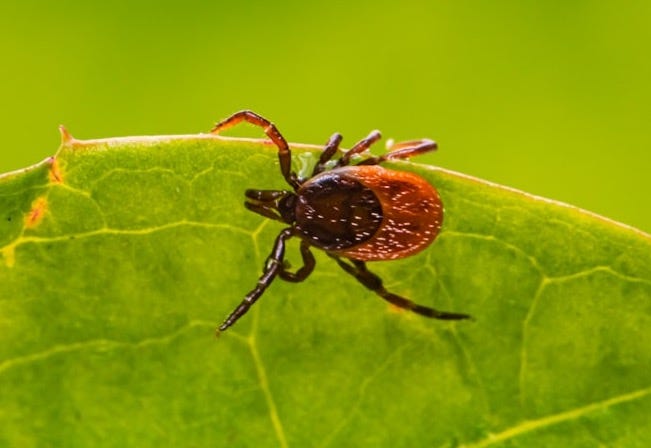
So why now? Follow the deer. The lone star tick’s range is marching northward on milder winters and an exploding deer herd, and this spring the CDC reported emergency-room visits for tick bites at their highest level since 2017. But the lone star tick is no longer the only suspect. The CDC now acknowledges the blacklegged (deer) tick can also transmit alpha-gal. This means the very species that blankets the Lyme-ridden Northeast and bites straight through winter may also be a problem. That quietly widens the high-risk area from the South to most of the eastern United States.
Regular readers know that I have a deep belief that every lens is biased, incomplete, and limited…and therefore insist on analyzing uncertain developments through multiple lenses. So what does a multi-lens analysis of AGS suggest?
The market lens. I run a frozen-pizza company, so let me confess my self-interest: pepperoni, sausage, and beef crumbles are mammalian. Every diagnosed case is a household quietly and (potentially permanently) exiting the red-meat market (and often the dairy market). This is not a fad diet subject to rapid changes in consumer sentiment. It is involuntary demand destruction, one bite at a time. The cattle, pork, and dairy complexes have spent years fretting over plant-based imitators and GLP-1 appetite suppression. They should add an arachnid to the watch list.
The biotech lens. Pfizer and Valneva just posted 73 percent efficacy in their Phase 3 Lyme vaccine trial; Moderna is advancing mRNA candidates to treat Lyme; and Tonix is testing a Lyme prophylactic. Notice the gap: every single one targets Lyme, not alpha-gal.There is still no vaccine and no cure for AGS, only avoidance. But that white space is unlikely to remain vacant. As part of a new federal plan, the NIH is now courting companies with products that could protect against AGS. Layer in emerging research tying alpha-gal sensitization to coronary-artery plaque, and the addressable population may dwarf the people currently breaking out in hives. And because the biotech and pharmaceutical industries tend to focus on large potential markets, we should all take notice.
The social contagion lens. As I mentioned above, this is generating headlines, and headlines change behavior. You don’t go from nine tests to 1,700 in five years (as happened on Martha’s Vineyard) unless people are starting to panic. Remember, a large portion of these are people proactively seeking an alpha-gal test because they heard about the problem. Regardless of the true positivity rate, concern about AGS is now a social contagion in the elite parts of the country with potentially large ramifications.
The policy lens. Increasing policymaker attention over the last month suggests greater visibility of AGS as a risk. Massachusetts made AGS a reportable condition and Congress is weighing legislation to classify alpha-gal as a major food allergen. Such a designation would increase labeling and foodservice training requirements. And in late June, HHS unveiled a national plan to combat tick-borne disease. It funds a pilot program to eradicate ticks on animals before they bite, backs reauthorization of the Kay Hagan Tick Act, and sets a 2035 target to cut Lyme diagnoses by a quarter. Regulators and legislators are notoriously overburdened with requests for their time; the fact that ticks are getting attention should concern all of us.
So what should an individual do? Treat clothing with permethrin; use DEET on skin; tuck pants into socks in brushy terrain; run a full-body tick check within hours of being outside; cut back the lawn edges and leaf litter where ticks lie in wait. If you’ve been bitten and later feel ill after meat, get the blood test — and if you’re positive and symptomatic, read every label, because alpha-gal hides in gelatin, broths, dairy, and even some drugs. Carry epinephrine if your physician advises it. Prevention costs a few dollars; the alternative can cost you, as one New Jersey family learned, far more than a hamburger.
AGS is an under the surface dynamic that justifies more attention as it may intensify into a more dramatic and disruptive phenomenon. While some might dismiss these developments as insignificant, my quick analysis suggests otherwise. After all, we can now link a tick on a Vineyard deer, by an unbroken chain of cause and effect, to demand for animal protein, the biotech pipeline, and even an act of federal policy. The dots are on the page. We need to connect them.
And perhaps most importantly, keep an eye out for little black dots on your legs.

VIKRAM MANSHARAMANI is an entrepreneur, consultant, scholar, neighbor, husband, father, volunteer, and professional generalist who thinks in multiple-dimensions and looks beyond the short-term. Self-taught to think around corners and connect original dots, he spends his time speaking with global leaders in business, government, academia, and journalism. He’s currently the Chairman and CEO of Goodwell Foods, a manufacturer of private label frozen pizza. LinkedIn has twice listed him as its #1 Top Voice in Money & Finance, and Worthprofiled him as one of the 100 Most Powerful People in Global Finance. Vikram earned a PhD From MIT, has taught at Yale and Harvard, and is the author of three books, The Making of a Generalist: An Independent Thinker Finds Unconventional Success in an Uncertain World, Think for Yourself: Restoring Common Sense in an Age of Experts and Artificial Intelligence and Boombustology: Spotting Financial Bubbles Before They Burst. Vikram lives in Lincoln, New Hampshire with his wife and two children, where they can usually be found hiking or skiing.