
Global Developments To Watch Over The Next Five Years
Twenty possibilities that should help you navigate uncertainty between now and 2031.

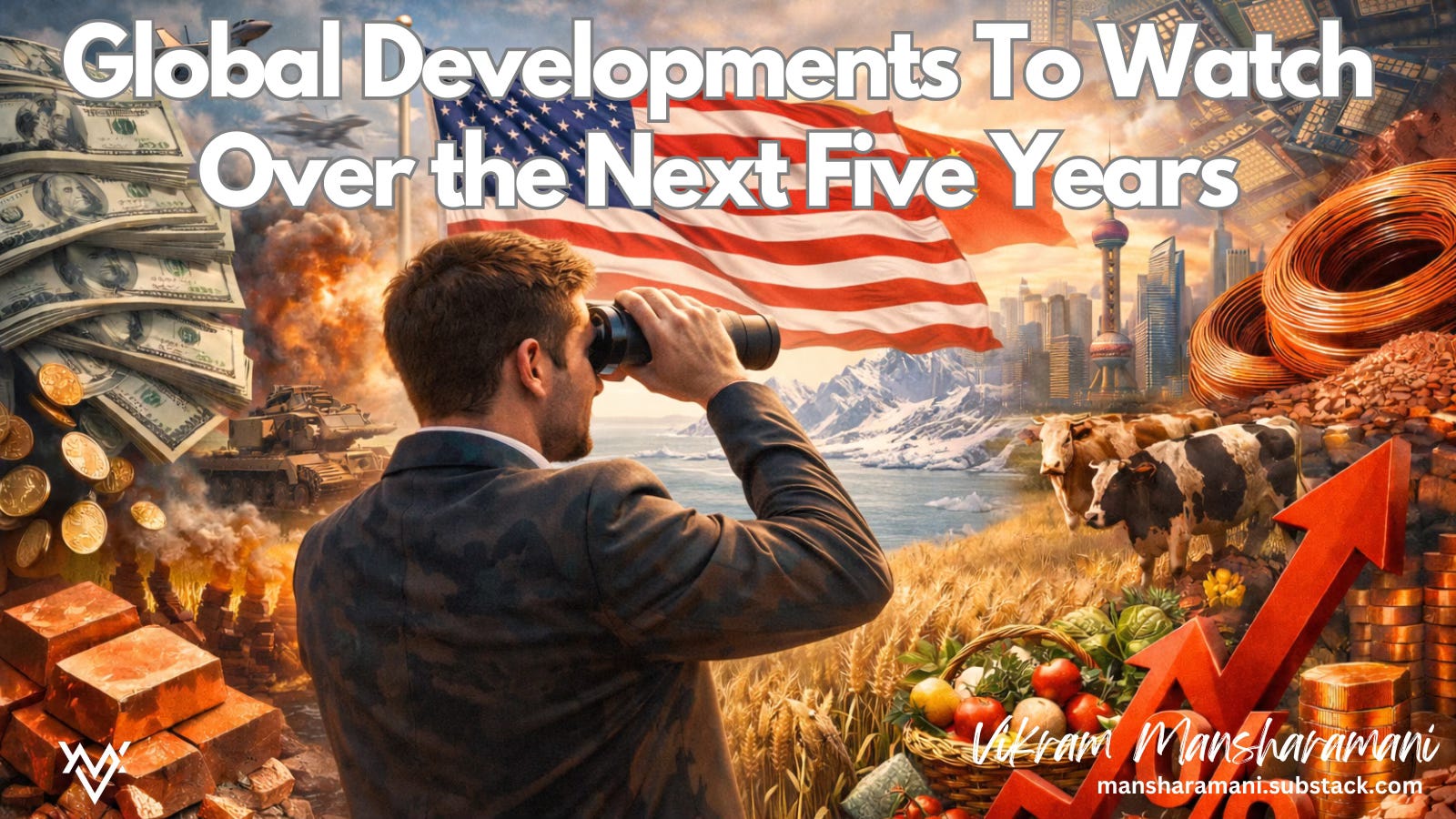
2025 will likely go down in history as one of the most eventful, action-packed years of the 21st century. The return of Donald Trump to the White House was perhaps the most consequential event, but the rapid rise of artificial intelligence and its voracious appetite for energy, China’s domestic deflation, and the ongoing conflicts in the Middle East and Ukraine competed for headlines. The Epstein files proved far more resilient than expected, gasoline prices plunged while gold surged, and many stock markets rose to new highs.
All of this took place while Thailand and Cambodia went to war, the nasty civil war in Sudan raged unabated, and South America began shifting right. The Gulf of Mexico was renamed the Gulf of America, and the Department of Defense became the Department of War. California endured horrific wildfires, Jamaica was hit by a category 5 hurricane, and the Intergovernmental Negotiating Committee on plastic pollution failed to reach any agreement. Union Pacific and Norfolk Southern agreed to merge, Google purchased cloud security firm Wiz for $32 billion in cash, and Chevron bought Hess. Newark struggled to keep its airport functioning, the government shut down, and the United States delivered a major blow the Iranian nuclear program. America also began preparations for its 250th birthday.
And let’s not forget what Dave Barry has called the biggest story of 2025: news that a devious raccoon broke into a Virginia liquor store and was found passed out in the bathroom. As Barry went on to note in his annual (must read) Year in Review, “that’s where the raccoon was found by a store employee, who called the animal-control officer, who took it to an animal shelter. When the raccoon finally sobered up, it was hired as director of security by the Louvre Museum.”
As I’ve stressed for years, uncertainty and change are realities of life from which none of us can escape. Yet we must all make decisions in the face of these fluid dynamics. What’s the best way to do so? Sadly, there is no one correct answer, but I believe we must look through the day-to-day noise to have any chance of identifying signals. Long-term trends that drive seemingly disconnected developments offer a compass to guide us through the numerous cross-currents that plague our lives; and as I’ve noted several times in the past, I believe this approach is at least marginally more useful than my Ouija board or Magic 8 ball.
Unlike others who tend to make predictions on a one-year view, I opt for a longer look as I believe time allows signals to surface amidst the deafening noise. I’ve been doing this since 2012 and have publicly posted my predictions since January 2015. (Links: 2015, 2016, 2017, 2018, 2019, 2020, 2021, 2022, 2023, 2024, 2025). I’d encourage you to revisit any or all of them, not just to see how wrong (and sometimes right!) I can be, but to also notice how the mere act of considering alternatives can be constructive. Accuracy has not (and is not) my objective. Instead, I offer these predictions with the hope they help you embrace uncertainty and think independently about the future.
1. The global use of GLP-1 drugs skyrockets as an oral pill becomes readily available and is covered by most health insurance plans or government health offices. Research emerges suggesting long-term side effects may be severe; drug companies respond with a flood of marketing dollars noting a life of chronic weight-related disease is worse. The single-serve food market booms. As the drugs decrease impulsive tendencies, consumer behaviors shift away from spontaneous decisions, leading to a structural headwind across a range of industries. Demand for buy-now-pay-later programs collapses.
2. Artificial intelligence generates deflation, leading to structurally rising unemployment and elevated debt levels. “The debt-deflation theory of great depressions” by Irving Fisher is read by everyone on Wall Street. Governments print money in a quest to produce inflation, leading to a surge in bitcoin, gold, commodity, and real estate prices. The perception of American debt as offering risk-free return is replaced by one in which treasuries are perceived as offering return-free risk. Unexpectedly, the US dollar stays strong, spurred in large part by massive inflows into dollar-linked stablecoins.
Golden Booms & Busts

I recently wrote about the surging price of eggs; they were so expensive that instead of a goose laying golden eggs, I joked, it was now chickens. The price of eggs is such that use of the cliche “worth their weight in gold” abounds. Ironically, what’s being overlooked is that if there is something that is worth its weight in gold, it’s, well, gold itse…
3. Beef prices plunge as the result of three simultaneous developments: (a) America’s cattle herd growing rapidly in reaction to current high prices; (b) Argentina and Brazil, to win favor with the Trump Administration prior to upcoming US elections, begin sending enormous volumes of beef to the United States instead of China; and (c) the beer industry repurposes fermentation infrastructure to produce lab-grown ground beef.
4. Birth rates in the developed world continue to fall, driven in large part by ongoing climate alarmism and declining marriage rates. The world’s largest economies age, leading to increasingly risk-averse (and short-term) investing and a rapid dissipation of entrepreneurial energy. Less money is invested in basic research and patent issuance slows to a trickle. China’s start-up culture withers as the one-child policy proves to be the Achilles heel of the Middle Kingdom’s desire to lead the world.
5. Bio-fabrication technologies advance rapidly enabling human organs to be printed on demand. A new industry of “body mechanics” emerges and utilizes AI-driven prediction models to pre-emptively replace joints, bones, and organs before they fail. The expected lifespan of a child born in 2030 rises to 151 years.
6. The insatiable consumer appetite for protein continues indefinitely. Restaurants start disclosing the protein content of menu items, the University of Washington designs a high-protein apple that is marketed across the country, and The Coca Cola Company introduces a high-protein soda. Public health deteriorates as Americans’ religious focus on protein leads to elevated consumption of sugars and artificial sweeteners.
7. Greenland declares independence from Denmark on the back of America’s agreement to acknowledge its status as a sovereign nation (Hmmm, remind you of Panama’s history?) In return for doing so, the United States is granted concessions to most of Greenland’s rare earths, several military bases on the island, and exclusive rights to underwater resources around the island nation. Unexpectedly, Greenland emerges as a major competitor to Norway and Chile in salmon farming.
Greenbacks for Greenland?

Even before he was sworn in to his second term, President Donald Trump’s public musings about acquiring Greenland — by purchase or by force — left ordinary Americans and elites alike puzzled by the seemingly erratic attention being paid to the Arctic island.
8. Canadian Prime Minister Mark Carney is ousted as the country recognizes that “diversifying” away from the United States is the wrong strategy in a world defined by the US-China War. Alberta Premier Danielle Smith, who has been consistently seen as a pro-American alternative, ascends to lead Canada. Simultaneously, but unrelatedly, improvements made to Venezuela’s oil infrastructure lead to a plunge in global crude oil prices and Canada’s worst recession in decades. Smith is bruised by the perception of economic incompetence, but survives and oversees a diversification of Canada’s economy beyond resource extraction and real estate.
9. As the battle between individualism and collectivism intensifies, sales of Ayn Rand’s books surge and classes on objectivism proliferate on college campuses. Zohran Mamdani’s popularity skyrockets and he emerges as the global torchbearer of the collectivist movement. Vivek Ramaswamy becomes the world’s leading cheerleader of individualism. The DEI movement retains a small but loyal following, marginalized to college campuses and a shrinking number of corporations.
10. Advancements in quantum computing lead to a geopolitical crisis as all formerly- secure communications become instantaneously vulnerable. Each breakthrough leads to a bump in gold prices as investors fear the possibility of quantum-enabled theft of cryptocurrency. Cybersecurity re-emerges as an area of top concern for corporate boardrooms, nation states, and individuals.
11. A boom in next generation nuclear technologies combines with improved hydrocarbon extraction efficiency to keep energy prices contained in the face of exploding demand from technology applications and data centers. As copper emerges as the world’s most strategic resource, the Great Powers shift their focus
from the Middle East to the Andean region.
12. The value of an elite education from top-ranked universities such as Harvard and Yale drops as the conservative-liberal political divide is trumped (pardon the pun) by an elite vs. common man dynamic. Skills-based education continues to gain share at the expense of liberal arts, leading to a plunge in critical thinking capabilities. Isaac Asimov’s Profession proves prophetic as independent thinkers are increasingly dismissed as “feeble-minded.”
Should We Educate Our Enemies?

It was a surreal moment…while Harvard’s graduation ceremony was underway last week, the Trump Administration’s effort to ban the school from enrolling international students was making its way through the courts. Alan Garber, the University’s President, took aim at this policy during his opening address when he welcomed graduating students from “
13. As technological advancements further concentrate wealth (and income) into fewer and fewer people, economic inequality (and youth unemployment) grows and leads to increasing mental health illness, deaths of despair, and widespread belief that the system is “rigged.” To dampen the risk of social unrest, several African governments begin covertly microdosing psilocybin into drinking water to help their citizens find meaning in a life without hope.
14. Guyana remains the fastest growing country in the world for years to come. The once under-developed jungle nation booms into a bustling economy as its oil reserves come online. In addition to the construction of five-star hotels, schools, data centers, and museums, Guyana also builds a new airport that is twenty times the size of Cheddi Jaggan International Airport and, with the announcement that COPA Airlines is moving its headquarters from Panama to Georgetown, is poised to become South America’s primary air travel hub.
15. Deepfake technologies become indistinguishable from real life, leading to mass human confusion and cognitive dissonance. Reality Defender emerges as the world’s hottest company as it secures elections by providing voters assurance of authentic messaging from candidates, thereby saving democracy from being hijacked by technologically-savvy foreign actors.
Deepfakes Have Arrived

Deepfake technology was on full display during the recent elections in Pakistan, as jailed former Prime Minister Imran Khan was able to rally support for his party with the assistance of artificial intelligence. Through the use of AI-powered voice cloning, he was able to disseminate his message to millions from behind bars.
16. Resource nationalism redefines global commodity markets and countries increasingly prioritize security of supply over price of product. Recycling efforts accelerate as countries increasingly turn to “urban mining” to obtain difficult to source commodities. Isolationists combine forces with environmentalists (strange bedfellows indeed!) to introduce tax and other incentives to promote self-reliant (and sustainable) recycling (obtaining resources without dependence on adversaries).
17. Venezuela and Nigeria opt (with American encouragement) to leave OPEC, leading to the organization’s slow demise as American-led hydrocarbon production booms. Dictators and strongmen emboldened and enriched by high oil prices attempt to raise prices by rapidly cutting production, but prices remain under $65/barrel. In an unexpected twist, increasing North American drilling (despite lower prices) leads to fewer carbon emissions.
Drill, Baby, Drill!

The world is fragile, something we all feel as wars rage, inflation persists, economies slow, and the climate changes. Unlocking America’s vast energy potential and aggressively developing our hydrocarbon resources is one strategy that could reduce geopolitical tensions, lower inflation, and yes, believe it or not, help save the environment.
18. Sensing a historic opportunity to “make a deal” with the Trump Administration over the status of Taiwan, Beijing offers to provide an uninterrupted supply of rare earths and advanced semiconductors to the United States from Taiwan if America acknowledges the island as a breakaway province of the People’s Republic of China. Knowing the United States will have significantly less dependence on Taiwanese chips or Chinese rare earths in a few years, Trump agrees to the deal with one caveat: the United States will run the island province until January 2029 and that Trump himself will preside over the official return of Taipei to Beijing control at that time.
19. The United Nations is increasingly acknowledged as ineffective and useless. Trump announces the United States will be evicting the United Nations from NYC and offers the prime land to developers. The concept of global governance dissipates as multilateralism and international governance lose credibility with everyone other than global elites.
20. As rising numbers start deferring to ChatGPT, Claude and Grok, synchronicity of thinking becomes visible globally. A “hive mind” starts forming, leading many to suggest that Apple, producer of the hit series Plur1bus (with an estimated budget of ~$15mm per episode!), used “alien communication” as a distracting narrative to enforce conformity of thought and enable the tech giant to grow even more powerful.
If you find the uncertainty inherent in thinking about the future distressing, please don’t! Remember that uncertainty and opportunity are two sides of the same coin — you can’t have one without the other! And it’s precisely in times of uncertainty that it’s possible to find opportunity by being curious, considering alternative futures, and thinking broadly. Consider the song “Upside Down” by Jack Jackson (popularized by Curious George):
Who’s to say what’s impossible?
Well they forget the world keeps spinning, and
With each new day, I can feel a change in everything…
And as the surface breaks, reflections fade,
But in some ways, they remain the same,
And as my mind begins to spread its wings,
There’s no stopping curiosity…
I wanna turn the whole thing upside down,
I’ll find the things they say just can’t be found…
Each year, I end my predictions with the prescient words of John Kenneth Galbraith, who eloquently captures the essence of forecasters. There are, he notes, two types: “those who don’t know and those who don’t know they don’t know.” Feel free to decide which you think I am, but I do hope that these possibilities are useful in spurring your thoughts.
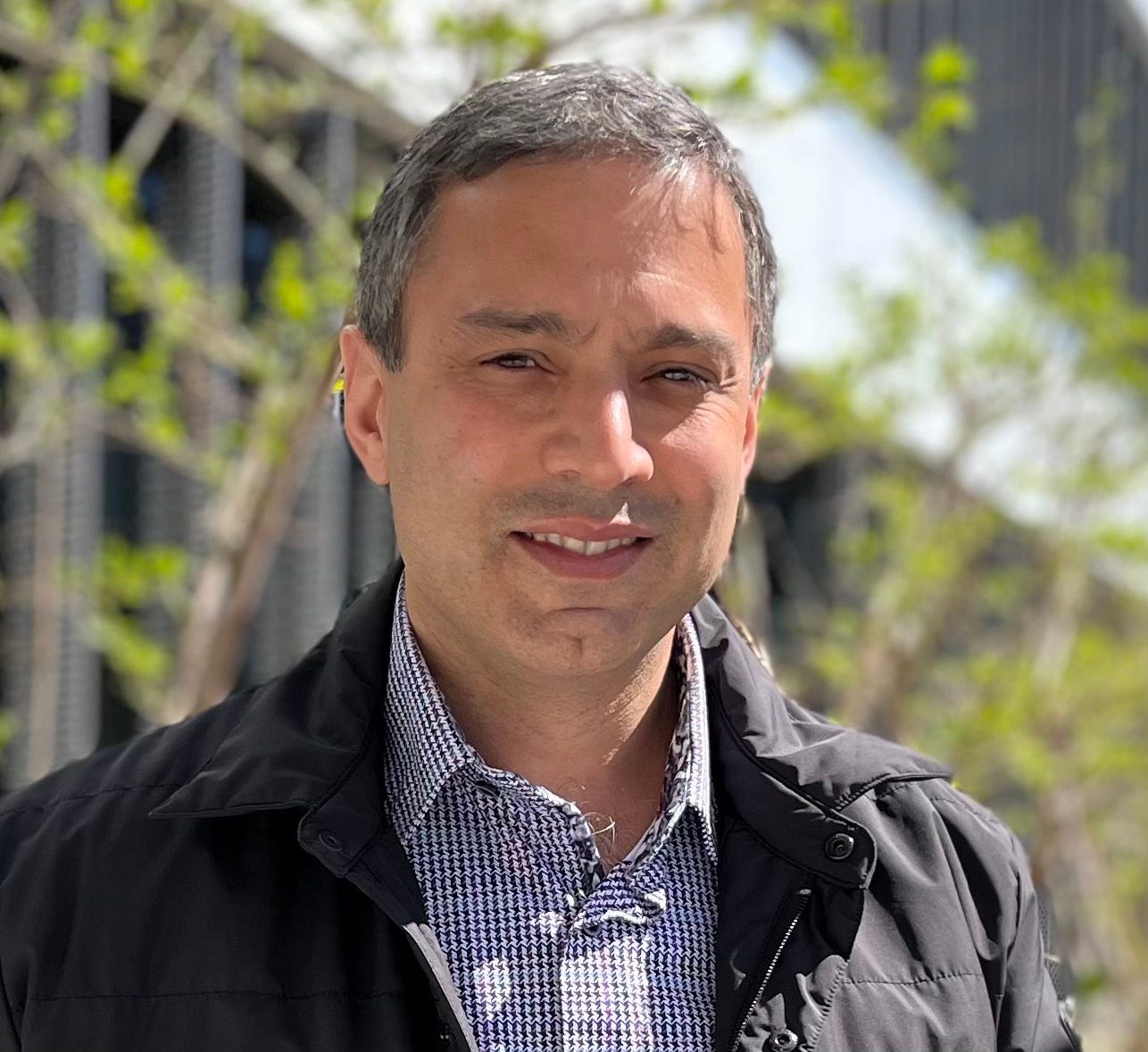
VIKRAM MANSHARAMANI is an entrepreneur, consultant, scholar, neighbor, husband, father, volunteer, and professional generalist who thinks in multiple-dimensions and looks beyond the short-term. Self-taught to think around corners and connect original dots, he spends his time speaking with global leaders in business, government, academia, and journalism. He’s currently the Chairman and CEO of Goodwell Foods, a manufacturer of private label frozen pizza. LinkedIn has twice listed him as its #1 Top Voice in Money & Finance, and Worthprofiled him as one of the 100 Most Powerful People in Global Finance. Vikram earned a PhD From MIT, has taught at Yale and Harvard, and is the author of three books, The Making of a Generalist: An Independent Thinker Finds Unconventional Success in an Uncertain World, Think for Yourself: Restoring Common Sense in an Age of Experts and Artificial Intelligence and Boombustology: Spotting Financial Bubbles Before They Burst. Vikram lives in Lincoln, New Hampshire with his wife and two children, where they can usually be found hiking or skiing.